
In Ohio, being found in contempt of court means that you have failed to comply with the terms of a court order or the authority of the court.
This can result in serious consequences, including fines, other sanctions, and, in extreme cases, jail time.
Cases are handled according to the precise circumstances and, in particular, the nature of the court order and the contempt shown to the court. This will ultimately dictate what happens next, but let’s look at some general truths concerning this.

Key Takeaways: Contempt of Court in Ohio
- Contempt of court generally involves failing to follow a lawful court order or disregarding the court’s authority.
- Family law contempt cases often involve child support, parenting time, custody, spousal support, or protection orders.
- Possible consequences include fines, additional court orders, purge conditions, and jail in serious cases.
- The original court order usually remains enforceable even after contempt proceedings have ended.
Types of contempt of court in Ohio
Contempt in Ohio is “a disregard of, or disobedience to, the orders or commands of judicial authority.” Contempt of court cases here generally fall into one of two categories:
Civil contempt
This is the most common type of contempt in Ohio. It usually occurs when someone fails to comply with a court order, often in family matters, such as divorces, where judges make legally binding decisions.
For instance, if a parent fails to pay child support as ordered by the court or violates a child custody or parenting agreement, the offender may be considered in contempt of court.
The offended party can file a motion for contempt at the local court to try to enforce compliance. This legal action should not be intended as punishment, but offenders can still face fines and jail time if they fail to comply with the order.
However, civil contempt that is punitive in nature may also be assessed live in Court if a party disobeys instructions or orders of the judge during Court appearances, such as a hearing or trial. For this reason, it is imperative to be on best behavior in court, be respectful of the judge and court staff, and to follow all instructions given to you during the court appearance.
Criminal contempt
In criminal cases, judges may issue orders that require compliance either by the defendant or another party involved in the case.
Often, criminal contempt cases are triggered by behavior that disrespects the court or obstructs justice, such as yelling in court, refusing to testify, or failing to comply with the terms of a probation order. This is generally considered more serious than civil contempt cases.
The main goal of contempt of court claims in criminal cases is punishment for disrespecting the court’s authority, with jail time up to 30 days, fines, or both possible. The guilty party may also be left with a criminal record.
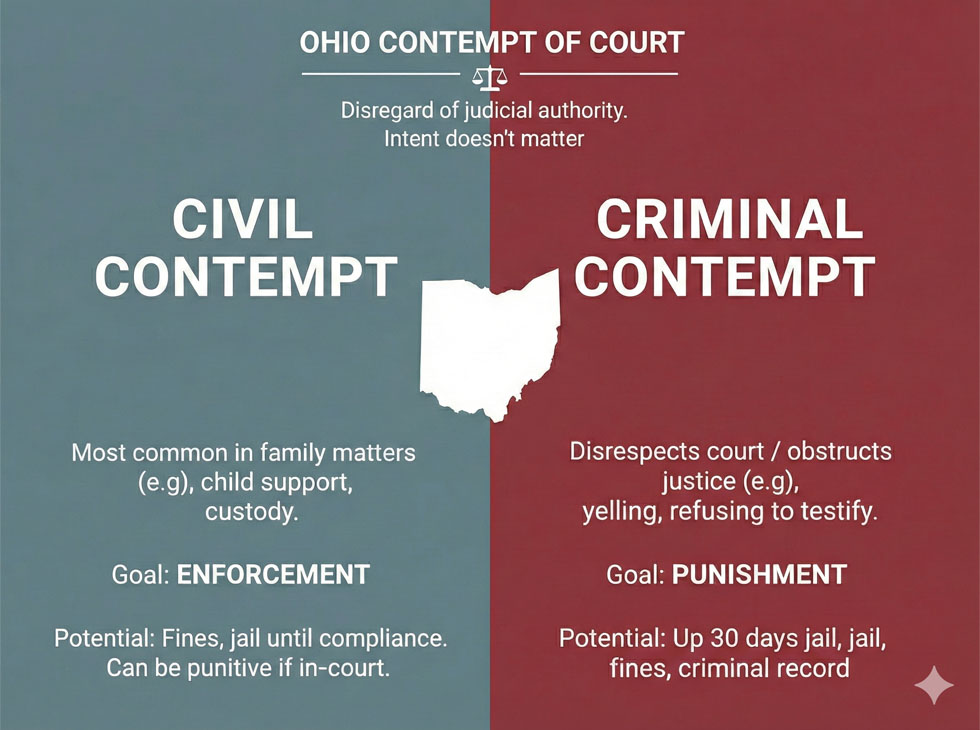
Note that in both civil and criminal contempt of court cases, the disobedience of or resistance to a lawful order or judgment does not need to be willful or intentional for a finding of contempt.
Accused of Violating a Court Order?
A contempt allegation does not tell the entire story. Nielsen Miller Law can help present evidence about your ability to comply, valid reasons for noncompliance, and efforts to follow the order.
What happens if you’re accused of contempt?
In family law cases, accusations of contempt are usually filed by the offended party—for instance, a parent who does not receive child support payments, an ex-spouse not receiving court-ordered spousal support, a parent being denied access to the children in a shared parenting arrangement, an ex-spouse who feels threatened by a breach of a protective order, etc.
Proceedings against the accused party usually begin with the offended party filing a motion for the offending party to show cause why he/she should not be held in contempt of court. This is designed to attempt to enforce compliance with the order. An Order to Show Cause is usually granted upon motion, commanding the other party to appear in court at the specified date and time.
From there, the following steps usually result:
- A court hearing will be held in front of the family law judge who issued the violated order.
- At the hearing, both parties have the opportunity to present their cases, with the help of legal counsel, if necessary.
- The judge will make a decision based on the evidence presented.
- If the judge finds the respondent guilty of contempt of court, a jail term can be imposed in cases of serious breaches, but fines, the loss of one’s driving license, or additional orders are more common in civil cases.
- Another resolution may be for the court to set “purge conditions,” which allow the offending party to “purge” the contempt, for instance, by paying a portion of the money owed or making up for lost parenting time by the offended party. If these conditions are met, the threat of sanctions may be lifted.
After contempt of court proceedings, the original order usually still stands. And so, the offender will still need to comply with the terms of that order during and after serving any sentence that may be imposed.
Having Trouble Enforcing a Family Court Order?
You may have legal options when child support, parenting time, custody, or another court-ordered obligation is being ignored. Get guidance before filing a contempt motion.
How is contempt proven in Ohio courts?
To prove contempt of court in an Ohio family court matter, the offended party must show the following:
- There was a court order and the order was violated.
- The offender was aware of the order.
- The offender was able to comply with the order.
- The offender did not have a valid excuse for the failure to comply.
The burden of proof is on the person alleging contempt in civil cases. So, if you wanted to hold someone in contempt of court for not providing court-ordered parenting time, you would need to prove that such an order existed AND that the other parent was able to comply but didn’t comply and had no valid reason for doing so.
If, for instance, the other parent was unable to drop off the children a couple of times because of adverse weather conditions, this would not be considered sufficient to succeed in obtaining a contempt order.
In most cases of non-compliance with a court order, matters should be resolved between the parties rather than taken to court. That is generally the expectation of the court.
What should you do if you’re accused of contempt of court in Ohio?
Depending on the nature of the contempt, you could risk a criminal record and harsh penalties. Even in civil cases in Ohio, jail time for contempt is not unknown, and even if the non-compliance is unintentional, there can be serious repercussions.
Therefore, your first move if you are accused of contempt of court should be to talk to an experienced family law attorney. With legal representation, your chances of escaping serious consequences improve greatly.
You will still need to attend hearings (failure to appear can lead to an arrest), but your family lawyer can help you gather and present evidence in your defense. Often, by demonstrating mitigating factors, an intention to comply in the future with the court order(s), and good faith efforts, your legal position can be improved.
Contact Nielsen Miller Law today for a 30-minute consultation or call us at 614-505-5555 to discuss your circumstances in detail and to learn how our experience and resources can work for you.
Facing or Considering a Contempt Motion in Ohio?
Whether you have been accused of violating a court order or need help enforcing one, Nielsen Miller Law can explain the process, prepare the necessary evidence, and help protect your interests. Contact the firm to request a consultation.
